

Systems mapping for Scotland’s built environment and energy infrastructure sectors
The Scottish Government has set an ambitious target of reaching net zero by 2045 and is looking to actively support the transition following the introduction of Scottish carbon budgets, the Circular Economy (Scotland) Act with its ‘Circular Economy and Waste Route Map to 2030’, and the new Circular Economy Strategy for Scotland.
What is clear is that reaching this goal cannot be achieved by government intervention alone. Coordinated action across industries will be needed to increase resource productivity, extend material lifetimes, and deliver the decarbonisation necessary to meet Scotland’s statutory targets and goals around waste reduction.
Targeting industry change on circularity
The Circular Economy (Scotland) Act 2024 identifies five sectors for targeted action, as embedding circular economy practices in these areas could have a transformative effect:
- Built environment (lifecycle assessments and reuse hubs)
- Energy infrastructure (circularity in decommissioning and critical raw materials)
- Textiles (addressing fast fashion, repairability, and waste exports)
- Food systems (reducing food waste and supporting bioeconomy innovation)
- Transport (circularity in EVs, batteries, and vehicle design)
Given their significant resource intensity and central role in delivering low-carbon infrastructure, the built environment and energy infrastructure sectors both have a critical role to play in the transition to a net zero society.
The possible emissions savings are huge: the built environment and construction sector currently accounts for 40% of CO2e emissions in Scotland1, with embodied carbon contributing up to 70% of a building’s total carbon emissions over its lifetime2.
Energy infrastructure is another complex area to tackle, with challenging decommissioning processes that yield large amounts of potentially recoverable waste materials. In Scotland alone, up to 241Mt3 of total materials are expected to be required to meet increasing renewable energy demands by 2050. This represents, at minimum, 12% more materials demand each year by 2050 than were directly consumed in Scotland in 2018; this could be as much as a 40% increase in materials demand per year by 20304.
The key to achieving a net zero transition will be to accelerate the shift away from linear models of consumption and production towards circular solutions. Zero Waste Scotland is leading the development of Roadmaps for energy infrastructure, the build environment, textiles and the bioeconomy. These are targeted action plans that guide priority sectors through Scotland’s transition to a circular economy.
Mapping issues and opportunities around circular change
Zero Waste Scotland commissioned Resource Futures to build a systemic understanding of the factors shaping the adoption of circular economy practices in both the built environment and energy infrastructure sectors, contextualising industry insights and experience to create useful tools that would galvanise industry stakeholders and inform intervention priorities going forwards.
The project was divided into two phases: research and development of draft systems maps, followed by testing and stakeholder validation.
In phase 1, alongside a rapid review of relevant available literature, our circularity experts held semi-structured interviews with 26 stakeholders from across industry, government, academia, and intermediary organisations. These charted the cultural, institutional, material, and social conditions that are shaping the take up of (or lack of engagement with) circular practices within the built environment and energy infrastructure sectors.
A total of 37 distinct factors influencing circularity were identified; these were used as the basis for the development of sector-specific and cross-sectoral systems maps.
In phase 2, data was analysed on stakeholder views collected at workshops and through a survey on the draft system maps and proposed interventions developed. Factors from phase 1 were reviewed and data from both phases was brought together to develop comprehensive systems maps and refine the list of most influential factors for both sectors.
The maps were developed using the SIPHER platform, which allows users to explore the systems maps in an interactive way – including accessing illustrative extracts from literature and interview data through the map itself.
Building accessible and insightful systems maps
The three system maps (built environment, energy infrastructure, and a cross-sector perspective) provide evidence-based insights on circularity within both sectors that can inform and support future decisions by policymakers and other stakeholders.
This includes perceived and experienced barriers and enablers, allowing users of the systems maps to not only identify the most influential factors in the ecosystem and their interconnections, but also to understand which will be easier or harder to influence.
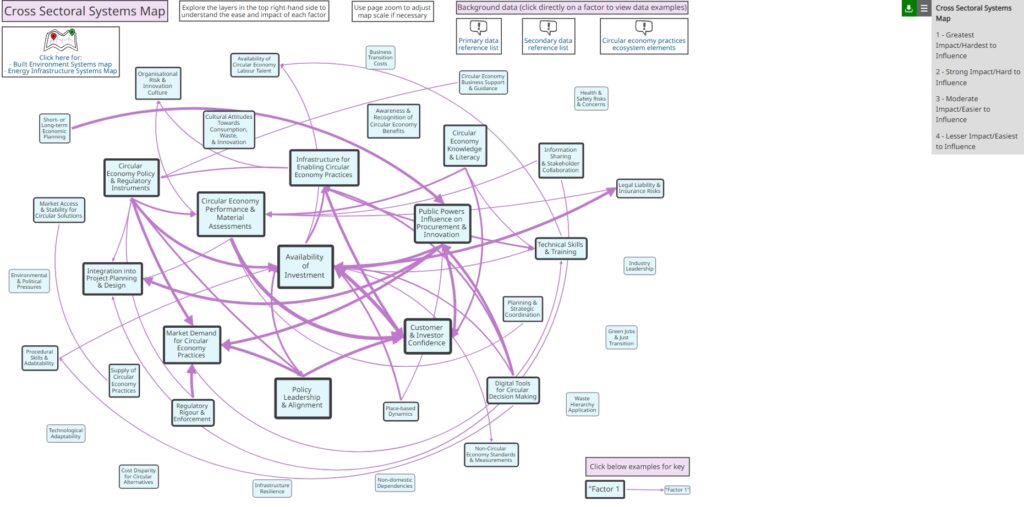
This research found that no single factor drives change in isolation, progress on the adoption of circular economy practices is shaped by the interplay between multiple factors. Seven core factors presented across both sectors emerged as influential:
- Availability of investment
- Public powers influence on procurement and innovation
- Circular economy performance and material assessments
- Customer and investor confidence
- Market demand for circular economy practices
- Policy leadership and alignment
- Circular economy policy and regulatory instruments
As the evidence from the project shows, many of these factors promise to deliver considerable impact but are difficult to influence. This highlights the need for sustained long-term work to address systemic barriers such as shifting industry culture, regulatory and policy frameworks, and leadership alignment. At the same time, changing infrastructure, markets, procurement and stakeholder networks may have moderate impact but can be easier to influence in the short term, providing opportunities to kickstart change and build confidence while longer-term systemic barriers are addressed.
Together, this distribution suggests that progress relies on pursuing momentum through the quicker wins – infrastructure, collaboration and market development – while gradually addressing the harder but more transformative cultural and leadership challenges.
The systems mapping project helped to inform the recently launched Energy Infrastructure Roadmap to Circularity. More information about Zero Waste Scotland’s stakeholder engagement and the systems maps can be found on their website.
You can also find the full roadmaps at the following links:
Energy Infrastructure Roadmap to Circularity
Built Environment Roadmap to Circularity
1: Scottish Government, Just transition for the built environment and construction sector
2: Clark, G. (2021) RIBA Sustainable Outcomes Guide. rep. London: Royal Institute of British Architects, p. 29
3: Zero Waste Scotland, Mapping material demand in Scotland’s energy infrastructure
4: Ibid
Project Information
Team involved
Violet Ross
Senior Consultant (on secondment at Defra)
Katie Reid
Consultant
Lloyd Howell
Junior Consultant (Communities)
Ann Stevenson
Circular Economy Lead (on secondment at Defra)

