
Helping local authorities reduce contamination with clear, effective communications strategy development
Supporting councils and the waste authorities with communications strategy development to prepare residents for Simpler Recycling
Local authorities across England are entering a period of rapid service change as the Government’s Simpler Recycling legislation comes into force. From March 2026, weekly food waste collections became mandatory, with flexible plastic collections following in 2027.
These changes are designed to address England’s persistently low recycling performance, which dipped slightly (by 0.2%) to 43.8%[i] in 2024. The ambition is that the changes being brought in through Simpler Recycling will set the country on the same path as Wales, which has achieved a UK-leading recycling rate of 68.4%[ii] thanks to decades of investment, engagement and consistency in collections across its local authorities.
As part of this transition, WRAP commissioned Resource Futures to work closely with two authorities – Bournemouth, Christchurch and Poole (BCP) Council, and a large urban waste authority serving multiple local councils – to develop a communications strategy for both that was practical and resident-focused. These needed to help residents sort and recycle materials correctly while preparing them for upcoming additional changes to their kerbside or communal collections.
Building a knowledge base
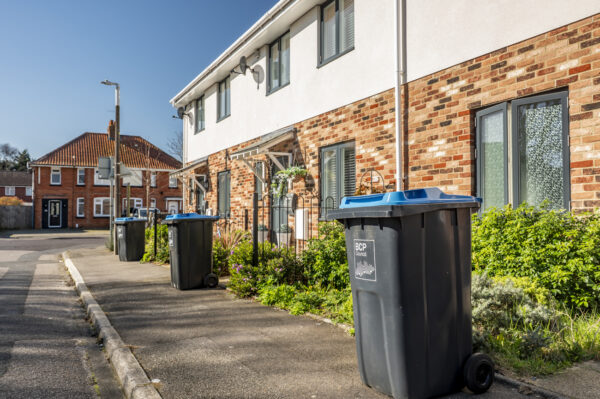
Each authority faced its own complexities. BCP Council needed a coherent set of communications that would tackle high levels of contamination in its dry mixed recycling. This included addressing non-target materials and items spoiled by food or liquid. BCP Council also saw an opportunity to start preparing residents for future flexible plastic collections, due to be introduced in early 2027.
With four borough councils to support, the waste authority we supported required a coordinated, yet locally adaptable, plan to reduce contamination and increase capture of recyclables. This campaign also included secondary focuses around the introduction of food collections, and encouraging engagement with reuse and repair activities.
An insight led, behaviour-centred approach
Effective waste communications must be grounded in a clear understanding of residents’ needs. Our experts began by analysing demographic and behavioural data – including MOSAIC and Output Area Classification (OAC) tools – to build a picture of the key audiences each authority needed to reach.
For BCP Council this analysis highlighted a clear divide in levels of digital access, which pointed towards a multi-channel approach being the best route to ensure messaging had an impact across all resident groups.
Meanwhile, the significant demographic diversity across the waste authority’s constituent boroughs, which includes many non–native English speakers, meant the communications approach needed to be flexible and focused on clear, easily understood core messages.
This analysis was combined with data on waste composition and insight into the distribution of property types, such as identifying areas with high densities of flats with distinct practical barriers – such as shared bin stores and communication challenges – which would benefit from a separate communications approach.
Additionally, existing digital and printed communications from each authority were reviewed and benchmarked against best practice from comparable councils to identify successful examples and possible approaches that could be applied to these contexts.
The insights gathered were applied to recognised behavioural models – COM-B, EAST and Push/Pull – to identify what would motivate residents to adopt better recycling habits and how communications could make desired actions easier and more intuitive.
Developing inclusive messaging frameworks
From the insights gathered, clear campaign directions emerged for each campaign.
For BCP Council, we developed an evolution of their existing messaging with an inclusive campaign centred on the tagline ‘Let’s recycle right’, focusing on civic pride, curiosity and shared responsibility to encourage residents to engage with recycling collections. This sits alongside a related but separate flats campaign centred around the idea of being ‘In it together’, which aims to engage with landlords, property managers and residents alike to encourage a shared responsibility for improving the recyclability of communal collections.
The waste authority’s ‘Together we can recycle better’ campaign focuses on clear, focused and memorable instructional messaging that clarifies best practice and reinforces the positive impact of recycling. This campaign ties in with WRAP’s ‘London recycles’ messaging (and adapts it to include repair and reuse messages) to reinforce the notion that this is a collective effort that the whole city is getting behind.
Creating flexible, practical communications plans
Both campaigns are designed as a phased, multi-channel strategy incorporating digital platforms, print materials, local venues, and, where relevant, school- or university-based outreach. For the urban setting covered by the waste authority, we recommended developing multi-language materials for non-native English speakers to widen accessibility to the messages being published and shared.
Where multiple councils needed to be involved, this process additionally involved creating an overarching partnership plan along with tailored activity schedules for each borough, adapting activities to suit different demographics, communication channels and implementation timelines. This approach ensures that the strategy can be delivered consistently across the waste authority while retaining local relevance where needed.
The communications plans for both clients were designed to be implemented immediately and adapted over time. To support delivery, we prioritised recommended actions based on cost and expected impact; this helps each authority decide how to deploy the campaign according to budget, capacity and the pace of service change – particularly important across the urban waste authority where food waste collections are being phased in gradually.
The work for BCP Council included conceptual designs for various communications outputs – including resident leaflets, digital signage, and social media posts – that could be adapted and evolved by the Council’s in-house design team to create the full suite of assets needed for the various stages of the campaign.
Laying the foundations for recycling improvement
These communication plans provide both clients with a clear and structured communications framework for improving recycling behaviours and preparing communities for upcoming service changes. Each plan is intentionally designed to evolve, offering opportunities to refine website layouts, expand social media presence and make better use of existing touchpoints over time.
While the campaigns share many similarities, there were some differences in approach: the needs of BCP Council resulted in a higher-level but end-to-end body of work from research through to detailed campaign plans and assets, while our work for the waste authority focused more on a deep dive into the data and resident needs, along with setting out the campaigns that would be needed so that each authority within the partnership could take the strategy forwards in an independent, but aligned, manner.
The campaigns will be rolled out across 2026 and 2027, with results monitored against key performance indicators recommended by Resource Futures. These measures will help track improvements in recycling quality, resident engagement and the effectiveness of campaign delivery over time.
“[The Waste Authority plan] is excellent! I’m really impressed with how much work and detail has gone into it, yet you’ve managed to present everything clearly and concisely. The level of detail in the activity schedules as well is excellent.”
Sally Wilson, Local Authority Technical Consultant at WRAP
“An insightful communications plan and activity schedule for our project on recycling contamination and recycling in flats. Clear messaging and campaign recommendations were highly valuable, and the team were professional, collaborative and a pleasure to work with throughout.“
Sarah Speakman-Jones, Strategic Waste Officer at BCP Council
[i] https://www.mrw.co.uk/news/england-household-recycling-rate-falls-by-0-2-percentage-points-for-2024-31-03-2026/
[ii] https://www.gov.wales/local-authority-municipal-waste-management-april-2024-march-2025-html
Project Information
Services involved
Team involved
Ben McCabe
Senior Consultant, Marketing Manager
Jacob Redfern
Junior Consultant
Lloyd Howell
Junior Consultant (Communities)
Steven Hedley
Junior Consultant
Sarah Hargreaves
Behaviour Change Lead
Danette O’Hara
Consultant
Katie Reid
Consultant
Bethan Jones
Director